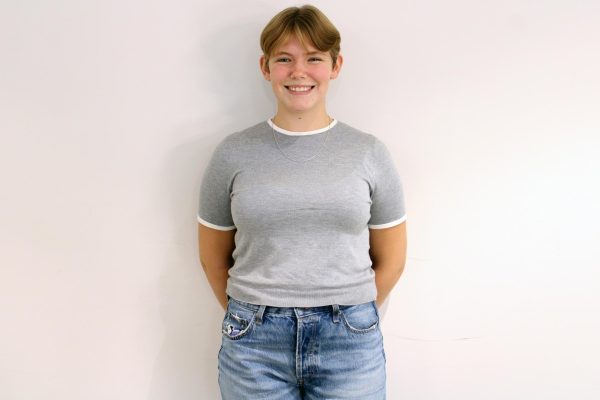


Environmental enthusiasts recently tested their ecological knowledge at the annual EcoMeet competition, an academic contest centered on local ecosystems and environmental stewardship. The event, which aims to get “young people more involved with their environment and caring about the world around them,” according to Junior Lauren Day, challenged teams of 3-4 students across four demanding segments: two specialized knowledge tests, an interpretive skit and a nature scavenger hunt.
This year’s competition focused intensely on wetlands and invertebrates, covering everything from species identification to the vital ecological role of these subjects in Kansas. Students highlighted the importance of wetlands.
“[Wetlands] provide habitats for all year and migrating species, boost biodiversity, and also suck carbon out of our atmosphere,” Day said.
Junior Segen Gish explained the comprehensive structure, detailing how the competition “expands student understanding of the natural sciences,” Gish said, “especially the topics central to Kansas’s unique wildlife and ecosystems.”
The challenges included a five-minute interpretation presentation — which senior Drew Foltz particularly enjoyed, describing his team’s imaginative skit as a “model UN meeting for a specific group of insects” — and the thrilling nature scavenger hunt.
Day loves the Nature Scavenger Hunt, where participants are set loose to identify and retrieve samples with the goal of receiving points for their team.
“[It is] so much fun, despite the difficulty of correctly identifying wild plants in the field,” Day said.
Gish also favored the focus test — a set of multiple choice questions about a certain group of animals, this year’s topic being invertebrates. Gish noted that the narrow study field makes it easier to apply learned facts in real life.
“Whether it’s identifying the animals themselves or the traces they leave behind. It gives a new depth to the seemingly simple environment we live in,” Gish said.
Although the team secured a respectable fourth place overall and earned a superlative for “best understanding of knowledge,” they narrowly missed qualifying for the state competition this year. Foltz acknowledged the difficulty, noting they were in a different, tougher regional.
“[We competed with] all of the top teams from the state,” Foltz said.
The team faced a serious test of resilience right before the event when a member had an emergency and was unable to attend. Fortunately, Foltz, a four-year veteran of EcoMeet, saved the day by stepping in. Foltz demonstrated incredible dedication, memorizing all of his lines for the interpretive skit in less than 12 hrs.
Gish added that Foltz “performed wonderfully,” which enhanced their participation in the crucial presentation. The stresses that competitions like this are essential because they help make students more aware and interested in the complex world around them, fostering greater engagement in conservation and environmental activism.
“I’m proud of how we did, and I’m excited to work hard for next year,” Day said.