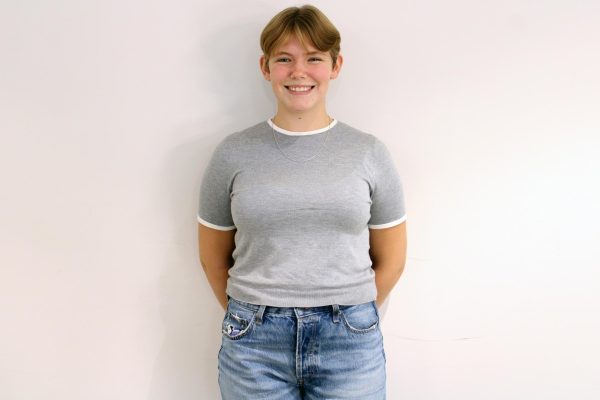


The Manhattan High School debate team made history this past weekend, securing a second-place trophy at the KSHSAA State 4-Speaker Debate tournament, ending an 11-year podium drought for the program.
Manhattan’s affirmative team (the team which advocates for the resolution in a debate) was led by seniors Wyatt Adams and Ayla Price, while the negative team (the team which opposes the resolution) consisted of senior Ryn Barnes and junior Natalia Buffington.
“It meant so much for the entire team to be able to make generational history by doing as well as we did,” Buffington said.
To even reach the State level, teams had to navigate a difficult regional qualifier where fewer than half of the competing schools moved on. Coach William Soper described the State atmosphere as a true “nail-biter,” particularly heading into the final round where Manhattan was locked in a tight race with Blue Valley West and Lawrence Free State for the runner-up spot. Both Manhattan pairs won their final debates of the day, making MHS the only school with nine wins and nabbing the second-place trophy.
The triumph was a surprise to the debaters, who were bracing for a different result during the awards ceremony.
“We originally thought we were fighting for third,” Buffington said. “So when they announced that Blue Valley West got third we were all a little sad. [But] when they announced that we got second we absolutely freaked out.”
The success extended beyond the four-speaker team, as Manhattan also sent several teams to the KSHSAA State two-speaker tournament. Seniors Emron Streetman and Cameron Williams, along with juniors Savannah Harvey and Dylan Spencer, both finished in the top 16. Manhattan was one of only three schools in the state to have two teams finish that high in the two-speaker bracket, a feat Soper says speaks to the “depth of our team.”
This followed another major milestone for the program just one week prior, when Adams and Price became the first team in MHS history to win the Kansas Debate Classic.
“It meant proving that, after a decade of no KDC or KSHSAA trophies, the students at Manhattan still have it,” Adams said.
Preparing for the State tournament required a month of intense research, often stretching into winter break. Unlike regular-season tournaments, the four-speaker format forces pairs to stick to one side of the argument for the entire competition. Barnes, who competed on the negative side, noted that the pressure was high because opponents often introduce new cases that haven’t been heard all year.
“For this topic and judging pool it can be quite difficult to win as the negative team since the affirmative team gets the last speech, but my partner and I went 5-2, and I’m extremely happy about that,” Barnes said.
Barnes recalled a particularly challenging round involving a new case about noise pollution in the Arctic where they had no prepared evidence but managed to win through quick thinking.
Beyond the trophies and awards, the students walked away with improved skills and lasting memories.
“This experience definitely improved my ability to think on my feet,” Buffington said.
While Adams noted that the ability to respond to arguments he had never debated before was a major takeaway. For the seniors, the victory was about the people as much as the points.
“I don’t think I’ll remember winning the KDC or being second at four-Speaker, but I will definitely remember my friends,” Adams said.
Barnes echoed that sentiment, emphasizing the support system that helped them succeed.
“Before our final round, many of our two-speaker debaters and Mr. Soper helped us prepare against this really unique affirmative we were about to go against. Winning that round felt like more than just me and my partner won it, it felt like the entire team won it,” Barnes said.
As the season concludes, the team hopes this historic run inspires more students to join the program.
“I would advise [new members] build a good foundation of friends within debate because it’s much more difficult to get to a position like this without that support,” Barnes said.
Adams, looking back on his four years in the program, encouraged new debaters to stick with it through the learning curve.
“I was bad at debate for a long time,” Sadams said. “In many ways, I still am. This isn’t easy… but most importantly, don’t think about competing with everyone else. I certainly can compete with my past.”